
Enrolment options
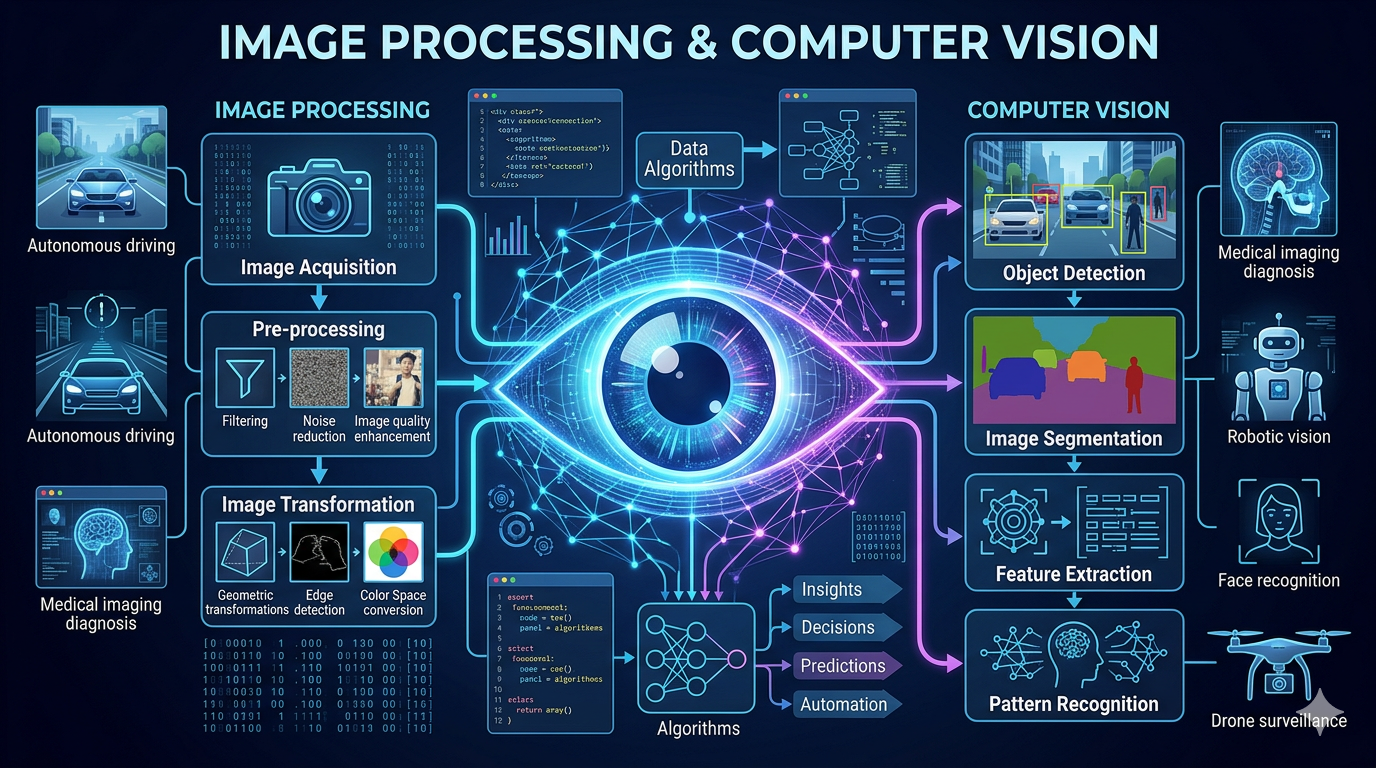
This course builds on the concepts introduced in Advanced Medical Imaging in Semester I and provides students with practical skills in image processing, computer vision, and the development of Artificial Intelligence (AI) and Machine Learning (ML) models for image-based analysis. The course focuses on the computational techniques used to extract meaningful information from digital images and visual data, particularly in biomedical and healthcare applications.
Students will be introduced to the fundamental principles of digital image processing, including image acquisition, enhancement, filtering, segmentation, feature extraction, and pattern recognition. The course also explores modern computer vision techniques and their integration with machine learning and deep learning frameworks to develop automated image analysis systems.
A strong emphasis is placed on hands-on implementation, where students will use widely adopted programming environments and libraries such as Python, OpenCV, and deep learning frameworks to design, train, and evaluate computer vision models. Through practical exercises and project-based learning, students will develop the skills needed to process medical images, detect patterns, and build AI-powered visual analysis tools.
By the end of the course, students will be able to design and implement computer vision pipelines, develop and evaluate machine learning models for image analysis, and apply these techniques to real-world problems in medical imaging, diagnostics, and biomedical research
Students will be introduced to the fundamental principles of digital image processing, including image acquisition, enhancement, filtering, segmentation, feature extraction, and pattern recognition. The course also explores modern computer vision techniques and their integration with machine learning and deep learning frameworks to develop automated image analysis systems.
A strong emphasis is placed on hands-on implementation, where students will use widely adopted programming environments and libraries such as Python, OpenCV, and deep learning frameworks to design, train, and evaluate computer vision models. Through practical exercises and project-based learning, students will develop the skills needed to process medical images, detect patterns, and build AI-powered visual analysis tools.
By the end of the course, students will be able to design and implement computer vision pipelines, develop and evaluate machine learning models for image analysis, and apply these techniques to real-world problems in medical imaging, diagnostics, and biomedical research
- Lecturer: wasswa william
Self enrolment (Student)
Guests cannot access this course. Please log in.